

How To Add More Money To Meal Plan Seattle U
The Required Costs of Existence a Seattle University Student

According to the Federal Pell Help received past the schoolhouse, 17% of Seattle University students fall under the category of low income. With the ascension costs of school, there are more and more students looking for ways to save money during their time in school. All Seattle U undergraduate students are required to live in on- campus housing for two years unless they fulfill the specific requirements for a waiver. Students are additionally required to purchase a meal plan the lowest standard plan being $1600 a quarter. Chartwells doesn't get any of the leftover money that students have when the quarter ends; this money stays with the university. Andrew Gaynor, the acting director of Dining Services, explained that Chartwells is because a change in the meal program amounts, given how much money students don't use and therefore lose every quarter. "It's too much to afford for most students that aren't paying for a repast plan. I used to merely not consume until I got abode at night because the cost of food on campus was just also much." Gaynor said that those amounts had been set past Bon Appetit, just they may be up for reconsideration. Gaynor also said that Chartwells has been discussing with Seattle U the possibility of increasing the maximum donation cap from its current $100 limit. This year, there accept been several price increases to food items as Chartwells adjusts to the school. Brie Bordner, the marketing director for Chartwells, said that these changes in cost happened subsequently the visitor took over Bon Appetit'due south contract, which had them go along prices the aforementioned for a year. "We try to mind and, within reason, talk about, 'Well is this too much or also little,'" Bordner said. "For example, the java terminal quarter was a large hit so we wanted to make sure that the price was depression enough to fit the needs of the students." Miranda Hernandez-Martinez, a third-twelvemonth sociology major is a member of the group Students for Economic Justice. She said she no longer eats on campus equally the price of food without a repast program is as well high. "It's too much to afford for most students that aren't paying for a meal programme," Hernandez-Martinez said. "I used to simply not eat until I got dwelling at night because the cost of nutrient on campus was just too much." The university is discussing solutions to combat loftier prices and meal plans, according to Dion Wade, the director of Campus Services. Wade is on an authoritative committee that decides what to ready the cost at for repast plans, OMA donations and works with the bookstore on their pricing. "The end goal is to ensure that students take access to the nutrition options that are here. And so the thought is why are students non utilizing the money and how can there be more than opportunities for students to feel like they are using their coin," Wade said. "We've been looking at different ways to do that, including giving students other places to spend money." According to David Stephen, the managing director of Housing and Residence Life, the reason that Seattle U has the requirement for students to spend 2 years living on campus is that studies have shown that living on-campus, students take reduced stress and therefore practise meliorate in classes. "Students are more continued to campus services, more connected to faculty and more continued to their peers, then they tend to exist more satisfied and feel a deeper connection to the school," Stephen said. "Seattle U is very tuition-dependent, so every student counts, and we desire to retain them equally much equally possible." Dani Jo Bechtold, a fourth-year social piece of work and sociology major and a member of the Students for Economic Justice, does non agree with the benefits of living on campus for two years that Stephen discussed. "Information technology definitely wasn't worth it. I am so glad that I was able to get off of campus and into existent space. They honestly charge you a ridiculous amount of money to share such a pocket-size infinite with someone else," Bechtold said. "I sympathise for the first twelvemonth, only by the 2nd year, it feels like they are but keeping us on campus to go all the money they tin can." Textbook costs is another area in which students spend a big amount of money, with required books sometimes costing hundreds of dollars. Marc Parrish, the Seattle U bookstore manager, is sympathetic to students who complain near the high prices of textbooks and hopes to ensure that the volume costs are non preventing students from learning. With the contempo move of course packs from SuperCopy to the bookstore, and an accompanying price-hike, the cost barrier grew larger in 2020. This is due to the markup at the bookstore that is college than SuperCopy's. Parrish said he is working on a solution on getting the price of books for students down. In a partnership with the Lemieux Library, Parrish is on the board of Textbook Admission and Affordability task force which works to reduce the corporeality of money that students spend on books every quarter. This commission was just formed this yr and works with the bookstore to figure out what books and articles are needed the about every quarter, then using the library'southward upkeep to buy them. "Our electric current process is looking at the data for what students demand, and we plan on reaching out to the campus to come across what kind of things they need from us," Parrish said. "We are defended to helping students get the books that they need, whether it means establishing a fund for students to get books or getting a little lending library for textbooks, we want to see students succeed." The Students For Economic Justice have been working to make campus services more attainable for low- income students. The club came about with a drove of students who identified equally low-income or low- income allies got together to assist and give a infinite for students like them. "For me, it kind of happened because there really weren't whatever resource on campus," Hernandez-Martinez said. "This society really gives me a identify to talk about this with other people who really understand me." Some of their electric current projects include working to go ORCA cards for students easier and organizing with groups on campus to increment the visibility of low-income students. There are many ways that students tin can piece of work to be allies to low-income students. One way is to purchase food for depression-income students who don't take a meal plan, which helps alleviate the nutrient security problems that some face on campus. With the contempo cuts to the OMA meal program donation service, Bechtold said it is also important to donate your extra meal plan money at the end of the quarter. With a partnership with the Outreach Center, you can as well donate textbooks that you no longer employ, and the Center volition rent them out for students cannot afford them. The SFEJ is too working with Campus Ministry to provide resources for students in demand, including a cap and gown for graduation, which can cost over 90 dollars. By altruistic a cap and gown to them that you won't need anymore, students who need it will save some coin. Logan may be reached at [email protected]
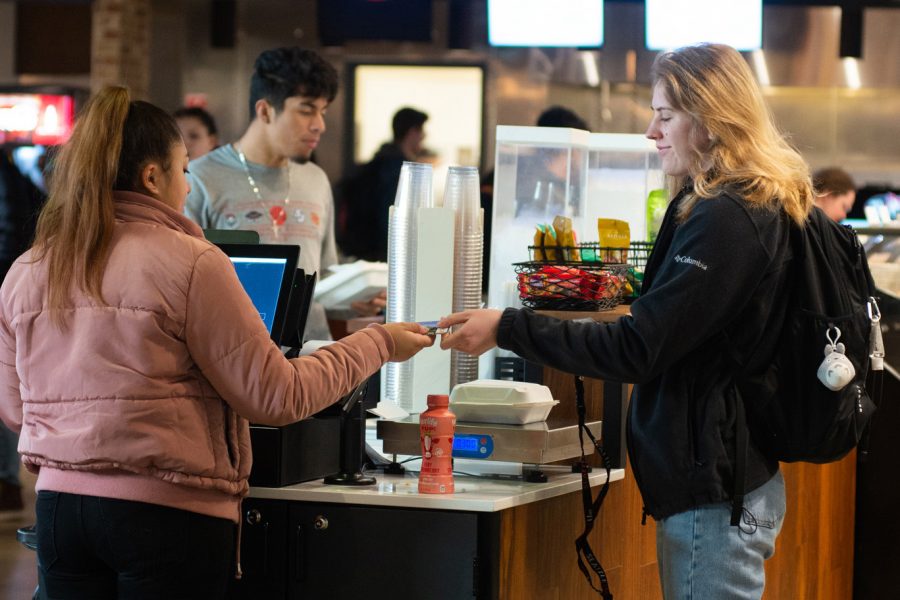
For their outset two years at Seattle U, students are required to have a minimum meal program of $1600.
Source: https://seattlespectator.com/2020/01/30/the-required-costs-of-being-a-seattle-university-student/
Posted by: fortnergodis1939.blogspot.com
0 Response to "How To Add More Money To Meal Plan Seattle U"
Post a Comment