

What Font Size Should Footnotes Be In Chicago Style
General Format
Summary:
This section contains information on The Chicago Manual of Fashion (CMOS) method of certificate formatting and citation. These resource follow The Chicago Manual of Manner (17th edition), which was issued in 2017.
Since The Chicago Manual of Style (CMOS) is primarily intended equally a style guide for published works rather than form papers, these guidelines will be supplemented with information from, Kate L. Turabian's Manual for Writers of Enquiry Papers, Theses, and Dissertations (8th ed.), which is largely based on CMOS with some slight alterations.
To come across a side-by-side comparison of the 3 most widely used citation styles, including a nautical chart of all CMOS citation guidelines, meet the Citation Style Chart.
Delight use the example at the bottom of this folio to cite the Purdue OWL in CMOS.
A Notation on Citations
Unlike many citation styles, CMOS gives writers 2 different methods for documenting sources: the Author-Engagement System and the Notes-Bibliography (NB) System.Equally its proper noun suggests, Writer-Date uses parenthetical citations in the text to reference the source's writer's terminal name and the year of publication. Each parenthetical citation corresponds to an entry on a References page that concludes the document. In these regards, Author-Engagement is very similar to, for instance, APA style.
By contrast, NB uses numbered footnotes in the text to direct the reader to a shortened citation at the bottom of the page. This corresponds to a fuller citation on a Bibliography page that concludes the document. Though the general principles of citation are the same hither, the citations themselves are formatted differently from the way they announced in Author-Date.
If you are using CMOS for school or piece of work, don't forget to ensure that you lot're using your organization'due south preferred citation method. For examples of these 2 unlike styles in action, run across our CMOS sample papers:
Author-Date Sample Newspaper
NB Sample Paper
Full general CMOS Guidelines
- Text should be consistently double-spaced, except for block quotations, notes, bibliography entries, table titles, and effigy captions.
- For block quotations, which are besides chosen extracts:
- A prose quotation of five or more lines, or more than 100 words, should be blocked.
- CMOS recommends blocking two or more lines of poetry.
- A blocked quotation does non get enclosed in quotation marks.
- A blocked quotation must always begin a new line.
- Blocked quotations should be indented with the word processor'due south indention tool.
- Folio numbers begin in the header of the first folio of text with Arabic number 1.
- Subheadings should be used for longer papers.
- CMOS recommends you devise your own format but use consistency as your guide.
- For CMOS and Turabian'south recommendations, see "Headings," below.
- CMOS recommends you devise your own format but use consistency as your guide.
Supplemental Turabian Way Guidelines
- Margins should be gear up at no less than one".
- Typeface should exist something readable, such as Times New Roman or Courier.
- Font size should exist no less than 10 pt. (preferably, 12 pt.).
Major Paper Sections
Title Folio
- According to Turabian fashion, class papers will either include a title folio or include the title on the beginning page of the text. Use the following guidelines should your instructor or context require a title page:
- The championship should be centered a third of the mode downwards the page.
- Your name, class information, and the date should follow several lines subsequently.
- For subtitles, end the championship line with a colon and place the subtitle on the line beneath the title.
- Double-infinite each line of the championship page.

CMOS Title Page
- Unlike practices utilize for theses and dissertations (run across Kate L. Turabian'due south A Manual for Writers of Research Papers, Theses, ad Dissertations [8th ed.].
Main Body
- Titles mentioned in the text, notes, or bibliography are capitalized "headline-style," significant first words of titles and subtitles and any important words thereafter should exist capitalized.
- Titles in the text as well every bit in notes and bibliographies are treated with quotation marks or italics based on the type of work they proper name.
- Volume and periodical titles (titles of larger works) should exist italicized.
- Article and chapter titles (titles of shorter works) should be enclosed in double quotation marks.
- The titles of virtually poems should be enclosed in double quotation marks, merely the titles of very long poems should be italicized.
- Titles of plays should be italicized.
- Otherwise, accept a minimalist arroyo to capitalization.
- For example, use lowercase terms to describe periods, except in the instance of proper nouns (e.g., "the colonial menses," vs. "the Victorian era").
- A prose quotation of v or more lines should be "blocked." The block quotation should lucifer the surrounding text, and information technology takes no quotation marks. To offset the block quote from surrounding text, indent the entire quotation using the give-and-take processor's indentation tool. Information technology is likewise possible to beginning the cake quotation by using a different or smaller font than the surrounding text.
In Flowers of Freedom: Reframing Political Thought, Rose eloquently sums up his argument in the following quotation:
In a gild of command, a politics of conduct is
designed into the fabric of existence itself, into the
organisation of space, time, visibility, circuits of
advice. And these enwrap each individual life
decision and activeness—nigh labour [sic], purchases, debts,
credits, lifestyle, sexual contracts and the like—in a web
of incitements, rewards, current sanctions and foreboding
of future sanctions which serve to enjoin citizens to
maintain item types of control over their conduct.
These assemblages which entail the securitization of
identity are not unified, only dispersed, non hierarchical
but rhizomatic, not totalized merely connected in a spider web or
relays and relations. (246)
References
- Label the outset page of your back affair, your comprehensive list of sources, "Bibliography" (for Notes and Bibliography style) or "References" (for Author-Date mode).
- Leave ii bare lines between "Bibliography" or "References" and your get-go entry.
- Leave one blank line between remaining entries.
- List entries in letter-by-alphabetic character alphabetical social club according to the beginning word in each entry, exist that the author'south proper noun or the title of the piece..
- Use "and," non an ampersand, "&," for multi-author entries.
- For two to three authors, write out all names.
- For four to 10 authors, write out all names in the bibliography but but the start author'due south name plus "et al." in notes and parenthetical citations.
- When a source has no identifiable author, cite it past its championship, both on the references page and in shortened form (upwardly to 4 keywords from that title) in parenthetical citations throughout the text.
- Write out publishers' names in total.
- Do non apply access dates unless publication dates are unavailable.
- If you cannot ascertain the publication date of a printed work, use the abbreviation "n.d."
- Provide DOIs instead of URLs whenever possible.
- If no DOI is available, provide a URL.
- If yous cannot name a specific page number when chosen for, you have other options: section (sec.), equation (eq.), volume (vol.), or annotation (due north.).
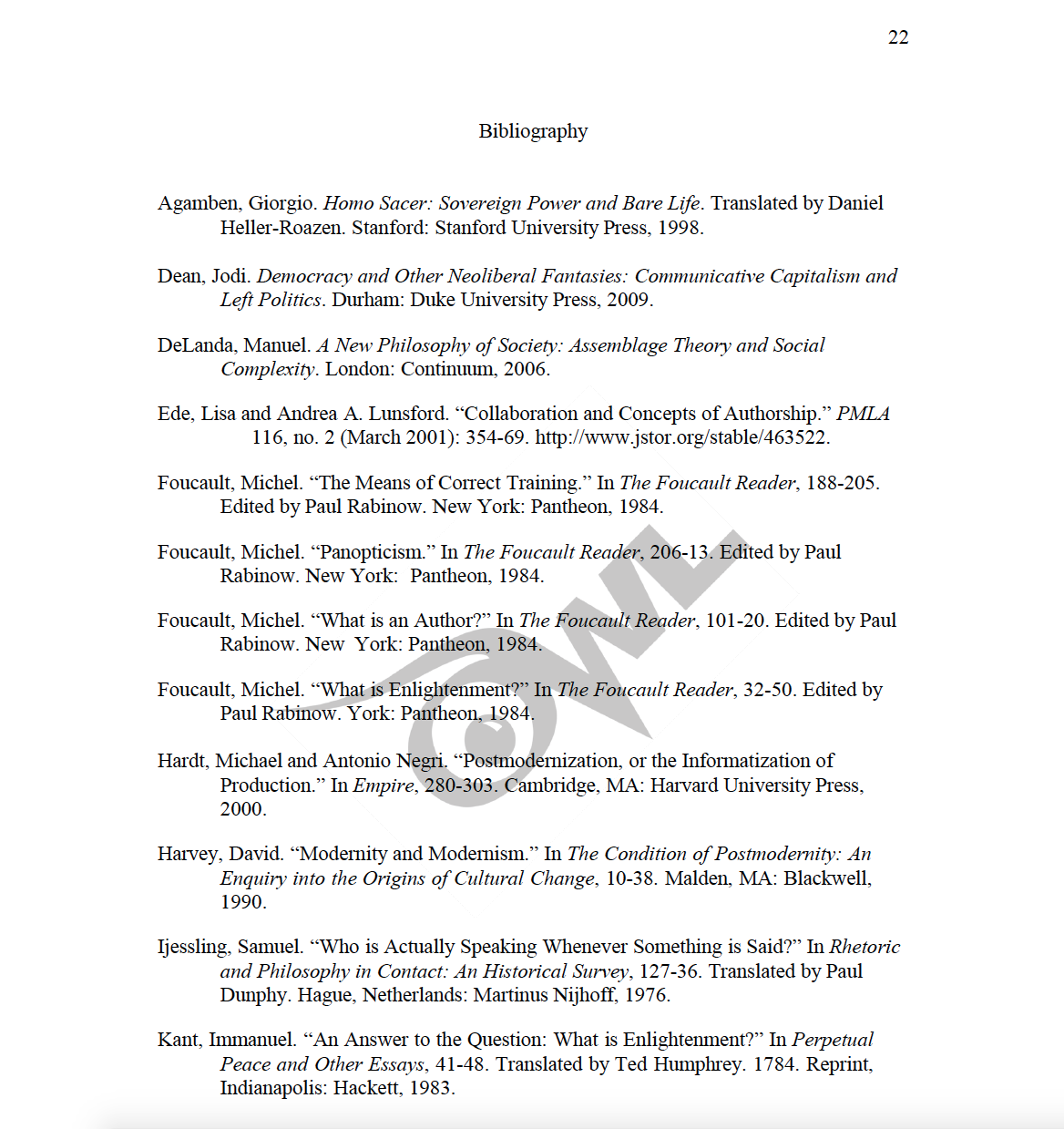
CMOS Bibliography Folio
Footnotes
- Note numbers should begin with "ane" and follow consecutively throughout a given paper.
- In the text:
- Note numbers are superscripted.
- Annotation numbers should exist placed at the finish of the clause or judgement to which they refer and should exist placed afterward all punctuation, except for the dash.
- In the footnotes:
- Notation numbers are full-sized, not raised, and followed past a period (superscripting note numbers in the notes themselves is also acceptable).
- Lines within a footnote should be formatted flush left. Place commentary after source documentation when a footnote contains both; separate commentary and documentation by a period.
- In parenthetical citation, split up documentation from brief commentary with a semicolon.
- Do not repeat the hundreds digit in a page range if it does non change from the beginning to the cease of the range.
For more information on footnotes, please see CMOS NB Sample Paper.
Headings
WhileThe Chicago Manual of Style does not include a prescribed system for formatting headings and subheads, it makes several recommendations.
- Maintain consistency and parallel construction in headings and subheads.
- Apply headline-mode for purposes of capitalization.
- Subheadings should begin on a new line.
- Subheadings tin exist distinguished by font-size.
- Ensure that each level of hierarchy is articulate and consistent.
- Levels of subheads tin can be differentiated past type style, use of boldface or italics, and placement on the page, usually either centered or flush left.
- Use no more iii levels of hierarchy.
- Avoid catastrophe subheadings with periods.
Turabian has an optional organisation of five heading levels.
Turabian Subheading Plan
| Chicago Headings | |
| Level | Format |
| 1 | Centered, Boldface or Italic Type, Headline-way Capitalization |
| two | Centered, Regular Type, Headline-style Capitalization |
| 3 | Affluent Left, Boldface or Italic Type, Headline-style Capitalization |
| 4 | Flush left, roman type, sentence-style capitalization |
| 5 | Run in at beginning of paragraph (no blank line subsequently), boldface or italic blazon, sentence-fashion capitalization, terminal period. |
Hither is an case of the five-level heading system:
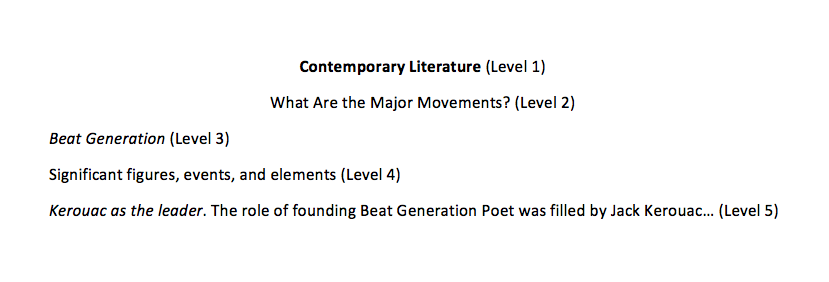
CMOS Headings
Tables and Figures
- Position tables and figures as shortly every bit possible after they are first referenced. If necessary, nowadays them after the paragraph in which they are described.
- For figures, include a explanation, or short caption of the effigy or analogy, directly after the figure number.
- Cite the source of the tabular array and figure information with a "credit line" at the lesser of the tabular array or figure and, if applicable, after the explanation. The credit line should be distinguished from the explanation by beingness enclosed in parenthesis or written in dissimilar type.
- Cite a source as you lot would for parenthetical commendation, and include total data in an entry on your Bibliography or References page.
- Acknowledge reproduced or adjusted sources accordingly (i.east., photograph by; data adapted from; map by...).
- If a table includes data not acquired by the author of the text, include an unnumbered footnote. Introduce the annotation by the word Source(southward) followed past a colon, and so include the full source information, and end the annotation with a period.
How to Cite the Purdue OWL in CMOS
On the new OWL site, contributors' names and the final edited date are no longer listed at the top of every page. This means that most citations will now begin with the title of the resource, rather than the contributors' names.
Footnote or Endnote (Northward):
1. "Championship of Resource," Listing the OWL equally Publishing Organisation/Web Site Name, https://owl.english.purdue.edu/owl/resource/717/02/.
ane. "Full general Format," The Purdue OWL, https://owl.english.purdue.edu/owl/resource/717/02/.
Corresponding Bibliographical Entry (B):
"Championship of Resources." List the OWL equally Publishing Arrangement/Spider web Site Name. http://Web accost for OWL resources.
"General Format." The Purdue OWL. https://owl.english.purdue.edu/owl/resource/717/02/.
Author Date In-text Commendation:
("Title" Year of publication).
("General Format" 2017).
Author Date References Page Citation:
Year of Publication. "Title of Resource." List the OWL as Publishing System/Spider web Site Proper name. http://Web address for OWL resource.
2017. "General Format." The Purdue OWL. https://owl.english.purdue.edu/owl/resources/717/02.

What Font Size Should Footnotes Be In Chicago Style,
Source: https://owl.purdue.edu/owl/research_and_citation/chicago_manual_17th_edition/cmos_formatting_and_style_guide/general_format.html
Posted by: fortnergodis1939.blogspot.com
0 Response to "What Font Size Should Footnotes Be In Chicago Style"
Post a Comment